Household preparedness
Food, water, essential supplies, documents and the practical needs of children, older relatives and pets.
Practical, bespoke emergency planning for you and your family — from prolonged power cuts to severe disruption.
Discuss your plan →Explore our servicesWhen everyday systems stop working, a collection of supplies is not enough. You need to know where to go, how to communicate and what to do first.
Tactical Planning helps you think through those decisions before pressure, uncertainty and disruption make them harder.
Our focus is households in Greater London and within the M25, with enquiries welcome from elsewhere in the UK. Plans take account of your location, family needs, property and budget.
Food, water, essential supplies, documents and the practical needs of children, older relatives and pets.
Backup power options, lighting, charging and alternatives when mobile networks or the internet are unavailable.
Compare staying at home, alternative accommodation and specialist shelter options, with their limitations made explicit.
Reunification arrangements, transport alternatives and decision points if normal travel is disrupted.
Prioritise useful equipment, organise storage and rehearse the tasks your plan depends on.
Explore premises, staff communications, critical records and operational dependencies through a separately scoped enquiry.
A serious incident can affect power, transport, communications and supplies at the same time.
We explore credible dependencies and contingency options, including severe conflict-related scenarios where requested. These are planning exercises, not predictions.
Explore the planning scenarios →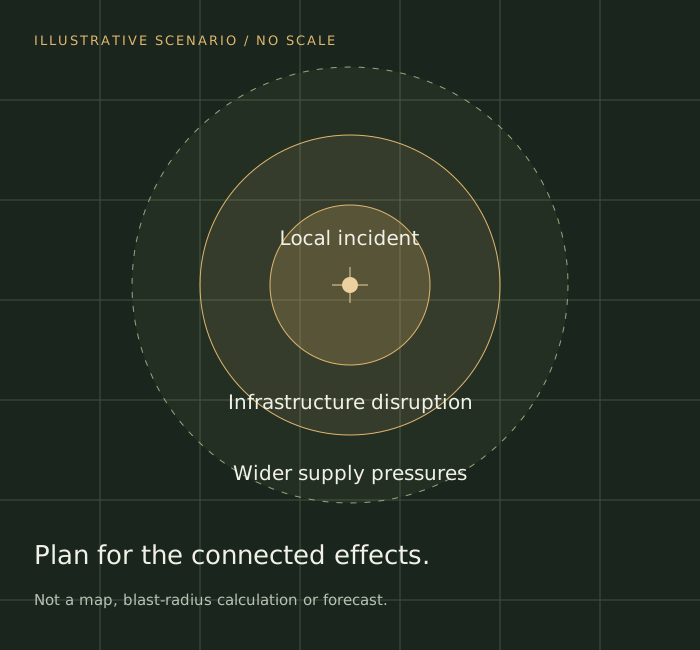
Conceptual impact graphic. Not a map, blast-radius calculation or forecast.
Tell us your general location, priorities and the level of preparation you have in mind.
Discuss your requirements →